Pearson Edexcel · GCSE · Psychology
Course version: 1PS0 · Version from Sept 2017
Criminal psychology - 6.2 Studies: 6.2.1 Bandura, Ross and Ross (1961)…
Full specification wording
Topic 6: Criminal psychology - 6.2 Studies: 6.2.1 Bandura, Ross and Ross (1961) Transmission of Aggression through Imitation of Aggressive Models
Bandura, Ross and Ross (1961) aimed to see if children would imitate aggressive behaviour from an adult model, and if the model's sex mattered.
Checked against the Pearson Edexcel 1PS0 specification (opens in a new tab) on .
- Point 1 of 2
Study notes
From the checked teaching notes for this specification point.
The idea
Bandura, Ross and Ross (1961) aimed to see if children would imitate aggressive behaviour from an adult model, and if the model's sex mattered. The procedure involved 72 children observing an aggressive model attacking a Bobo doll, a non-aggressive model, or no model. After mild aggression arousal, children were observed playing. Findings showed children exposed to the aggressive model displayed significantly more imitative aggression. Boys were more likely to imitate same-sex models. A strength is the highly controlled laboratory setting, ensuring high reliability. Weaknesses include low ecological validity, as hitting a doll differs from real-world aggression, and ethical issues regarding exposing children to aggressive acts.
What earns the marks
- Identify the aim of Bandura, Ross and Ross (1961) as investigating the imitation of aggressive models.
- Recall that the sample consisted of 72 children who were divided into aggressive, non-aggressive, and control conditions.
- Recognise that a key finding was that children exposed to the aggressive model showed more imitative aggressive behaviour.
- Identify a weakness of the study, such as low ecological validity or ethical concerns regarding the protection of participants from psychological harm.
Common mistakes and how to put them right
Stating that the study proves all aggression is learned.
Put it right: The study demonstrates that specific aggressive behaviours can be imitated in a controlled setting, but it does not rule out biological factors.
Confusing the independent and dependent variables.
Put it right: The independent variables included the model's behaviour and sex, while the dependent variable was the level of aggression displayed by the children.
Claiming the study had high ecological validity.
Put it right: The study took place in an artificial laboratory setting with a Bobo doll, which lacks ecological validity compared to real-world aggression.
Exam tips
- Memorise the specific number of participants (72 children) and the three main conditions (aggressive, non-aggressive, control) for multiple-choice questions.
- Be prepared to identify the specific types of aggression measured, such as physical and verbal imitative aggression.
- When asked for a weakness, focus on the ethical issue of deliberately exposing children to aggressive behaviour without protecting them from potential psychological harm.
Try the lesson
The start of the Topic 6: Criminal psychology - 6.2 Studies: 6.2.1 Bandura, Ross and Ross (1961) Transmission of Aggression through Imitation of Aggressive Models lesson, made from checked teaching notes for this specification point.
Have a go first
What was the main aim of the study by Bandura, Ross and Ross (1961)?
Listen
Bandura, Ross and Ross (1961) aimed to see if children would imitate aggressive behaviour from an adult model, and if the model's sex mattered. The procedure involved 72 children observing an aggressive model attacking a Bobo doll, a non-aggressive model, or no model. After mild aggression arousal, children were observed playing. Findings showed children exposed to the aggressive model displayed significantly more imitative aggression. Boys were more likely to imitate same-sex models. A strength is the highly controlled laboratory setting, ensuring high reliability. Weaknesses include low ecological validity, as hitting a doll differs from real-world aggression, and ethical issues regarding exposing children to aggressive acts. A strong answer earns marks for these points. Identify the aim of Bandura, Ross and Ross (1961) as investigating the imitation of aggressive models. Recall that the sample consisted of 72 children who were divided into aggressive, non-aggressive, and control conditions. Recognise that a key finding was that children exposed to the aggressive model showed more imitative aggressive behaviour. Identify a weakness of the study, such as low ecological validity or ethical concerns regarding the protection of participants from psychological harm. A common slip: Stating that the study proves all aggression is learned. Instead, The study demonstrates that specific aggressive behaviours can be imitated in a controlled setting, but it does not rule out biological factors. Exam tip: Memorise the specific number of participants (72 children) and the three main conditions (aggressive, non-aggressive, control) for multiple-choice questions.
See it
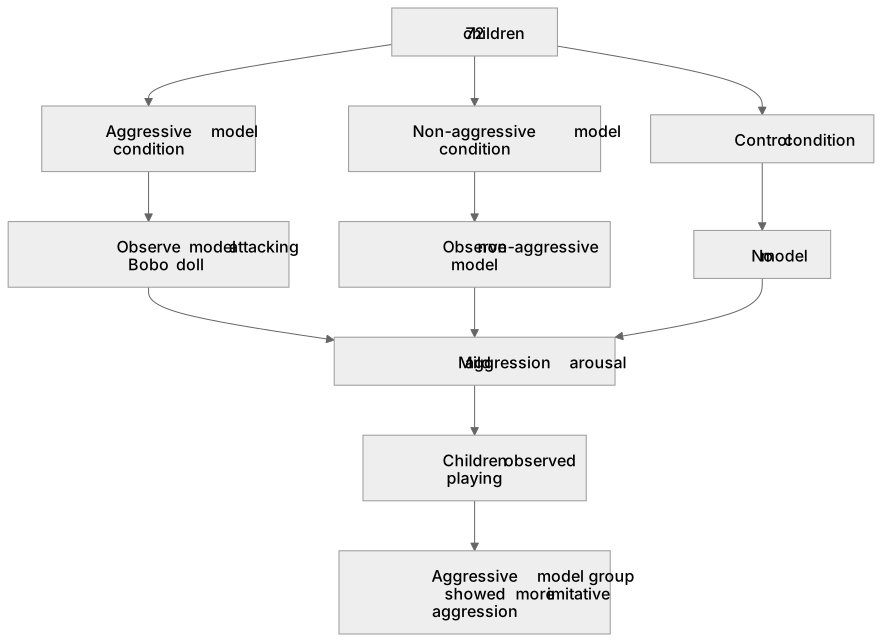
Label the diagram
Some boxes have lost their names. Pick the right name for each number.
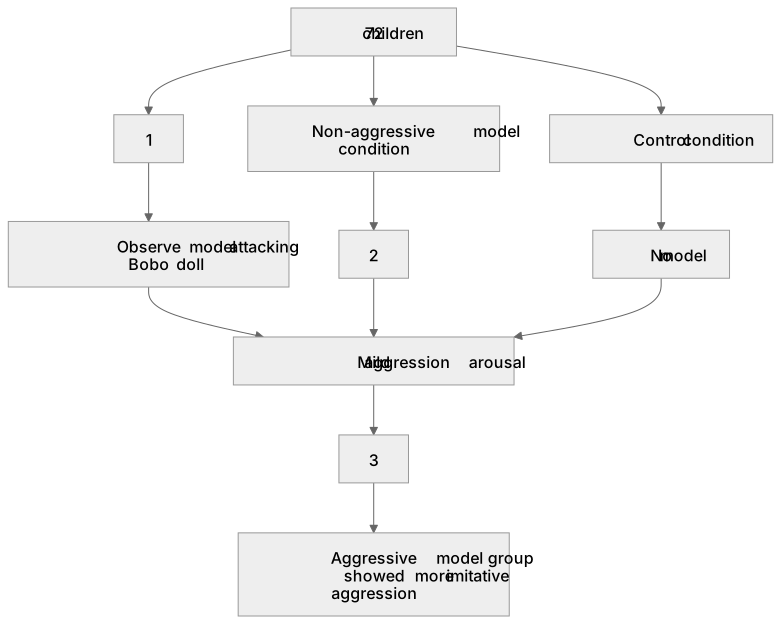
1Box 1
2Box 2
3Box 3
There is more to this lesson
The full lesson goes on to check your understanding and help you earn the marks. Create a free account to carry on, with your progress saved.
A week of Premium from your first lesson · Then the free plan continues · No card, no charge
Test your understanding of Topic 6: Criminal psychology - 6.2 Studies: 6.2.1 Bandura, Ross and Ross (1961) Transmission of Aggression through Imitation of Aggressive Models
Active recall beats re-reading. Take an instant quiz now to test what you’ve learned and lock it into long-term memory.
A week of Premium from your first lesson · Then the free plan continues · No card, no charge